Have a great year and don't be afraid to take a risk and don't be afraid to fail because you took a risk. It is truly the way we all become better.You can't expect your students to take risks if you're not willing to do it yourself. Let's have a great school year.
Wednesday, August 31, 2011
The wisdom of Ray
Ray left this in the comments of the last blog. I put it here so that everybody who stops by can see it. And if it's just Ray and me who see it...well, at least I won't have to go into the comments in order to re-read it.


Sunday, August 28, 2011
The Big Idea of big ideas
Part II:
We've had key ideas of classes re-packaged and re-sold to us in so many ways, it's tough to know where to begin, or what action to take. Here, to help the confused and unwary, a brief overview of everything.
(Caveat lector: If you thought the last one was bad, go no further. The concepts are murkier, the definitions are longer, and the jokes are worse. There's even a bibliography.)
(Special note to education students: After reading this, you're likely to be more confused about one of the most important concepts in education than you were before. That's okay: you'll be in the same position as everybody.)
We've had key ideas of classes re-packaged and re-sold to us in so many ways, it's tough to know where to begin, or what action to take. Here, to help the confused and unwary, a brief overview of everything.
(Caveat lector: If you thought the last one was bad, go no further. The concepts are murkier, the definitions are longer, and the jokes are worse. There's even a bibliography.)
(Special note to education students: After reading this, you're likely to be more confused about one of the most important concepts in education than you were before. That's okay: you'll be in the same position as everybody.)
Monday, August 22, 2011
"How did YOU spend your summer break, Señor Cosby?"
Trying to learn how to do this, kids:
In other news, you can tell I'm getting tetchy to go back to school. All my blog posts are imaginary conversations.
In other news, you can tell I'm getting tetchy to go back to school. All my blog posts are imaginary conversations.
Thursday, August 18, 2011
"Good lord. What ARE you teaching these kids?"
or,
The Big Idea of big ideas
Part I: Overview and background knowledge
"Welcome to English class, ladies and gentlemen. We're going to learn a lot in this class."
"Excuse me, teacher. What are we going to learn?"
"A lot."
"Well, right, you said. But a lot of what?"
"A lot of English."
"Okay. Well, I already know a lot of English. Can I go?"
We've had key ideas of classes re-packaged and re-sold to us in so many ways, it's tough to know where to begin, or what action to take. Here, to help the confused and unwary, a brief overview of everything.
(Caveat lector: This goes on for a while. Only click through if you have some time on your hands.)
(Special note to education students: The definitions below appear in none of your textbooks. If you use them on your tests, your professor will fail you. On the other hand, the business college is always ready to take dropouts from the other schools, and I hear they pay their interns.)
The Big Idea of big ideas
Part I: Overview and background knowledge
"Welcome to English class, ladies and gentlemen. We're going to learn a lot in this class."
"Excuse me, teacher. What are we going to learn?"
"A lot."
"Well, right, you said. But a lot of what?"
"A lot of English."
"Okay. Well, I already know a lot of English. Can I go?"
We've had key ideas of classes re-packaged and re-sold to us in so many ways, it's tough to know where to begin, or what action to take. Here, to help the confused and unwary, a brief overview of everything.
(Caveat lector: This goes on for a while. Only click through if you have some time on your hands.)
(Special note to education students: The definitions below appear in none of your textbooks. If you use them on your tests, your professor will fail you. On the other hand, the business college is always ready to take dropouts from the other schools, and I hear they pay their interns.)
Wednesday, August 17, 2011
Articles like this get my goat
From the local rag:
"Here is the list of Kalamazoo-area schools that failed to make AYP."
In all fairness, I know that the author, Julie Mack, is generally a proponent of public education, although sometimes it would be hard for a casual observer to tell. On her blog published not six hours later, she calls for a reform of NCLB. Even in this article, she doesn't necessarily do anything wrong--she presents the information as it exists, in as succinct a form as the language will permit.
But when a parent reads this article, what they see is "Your school failed." When an opponent of public education (or an "education reformer") reads this article, they see "Public schools fail." Then there are the comments. (I try not to read the comments in my local rag, because they inevitably infuriate me. I understand that this is a common pattern among the comment section of newspapers online. I read the first one on accident.)
Look, I'm on the data train. I think we need good data to make the right decisions. All stakeholders in education (which, the first comment on the "Your School Failed" article reminds me, is everyone) should have access to information about the achievement of their schools. Saying that all schools are wonderful! obviously doesn't make schools better places. There is no need to sugar-coat our shortcomings. There's no reason we shouldn't ask the community for input on how to improve, and every reason to do so.
This kind of thing, however, doesn't further that conversation in any meaningful way. It casts aspersions in the guise of providing information. It takes as its premise a flawed idea, the idea that naming and shaming is the first best tool for school improvement. To reiterate, I'm certain that this is not what Ms. Mack intends to do, but I don't know that a reader could help but to see it as an accusation.
"Here is the list of Kalamazoo-area schools that failed to make AYP."
In all fairness, I know that the author, Julie Mack, is generally a proponent of public education, although sometimes it would be hard for a casual observer to tell. On her blog published not six hours later, she calls for a reform of NCLB. Even in this article, she doesn't necessarily do anything wrong--she presents the information as it exists, in as succinct a form as the language will permit.
But when a parent reads this article, what they see is "Your school failed." When an opponent of public education (or an "education reformer") reads this article, they see "Public schools fail." Then there are the comments. (I try not to read the comments in my local rag, because they inevitably infuriate me. I understand that this is a common pattern among the comment section of newspapers online. I read the first one on accident.)
Look, I'm on the data train. I think we need good data to make the right decisions. All stakeholders in education (which, the first comment on the "Your School Failed" article reminds me, is everyone) should have access to information about the achievement of their schools. Saying that all schools are wonderful! obviously doesn't make schools better places. There is no need to sugar-coat our shortcomings. There's no reason we shouldn't ask the community for input on how to improve, and every reason to do so.
This kind of thing, however, doesn't further that conversation in any meaningful way. It casts aspersions in the guise of providing information. It takes as its premise a flawed idea, the idea that naming and shaming is the first best tool for school improvement. To reiterate, I'm certain that this is not what Ms. Mack intends to do, but I don't know that a reader could help but to see it as an accusation.
Sunday, August 14, 2011
A timely webcomic
I don't remember if I've re-posted XKCD comics before. But Randall Munroe is one of my favorite webcomic authors, and he often has keen insights.
Friday's was especially timely. As I mentioned, on Thursday and Friday I went to a training (along with an extraordinary number of St. Joseph County's best and brightest) on Marzano's Formative Assessments and Standards-based Grading. One of the key ideas of Thursday's training is that a traditional, letter-grade-based-on-a-100%-scale grading system is almost useless, and that averaging grades together is no way to show a student what she has learned. (Friend and regular commenter Ray told me so in a comment in an earlier post.)
Friday morning's XKCD:
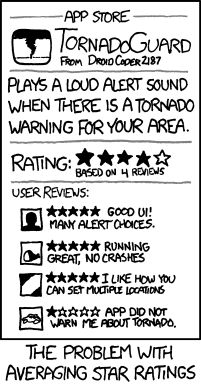
Friday's was especially timely. As I mentioned, on Thursday and Friday I went to a training (along with an extraordinary number of St. Joseph County's best and brightest) on Marzano's Formative Assessments and Standards-based Grading. One of the key ideas of Thursday's training is that a traditional, letter-grade-based-on-a-100%-scale grading system is almost useless, and that averaging grades together is no way to show a student what she has learned. (Friend and regular commenter Ray told me so in a comment in an earlier post.)
Friday morning's XKCD:
Wednesday, August 10, 2011
Another educator who does everything better than me...
...writes a blog better than I do.
Peter Pappas's blog Copy / Paste seems full of practical suggestions to do the kinds of things I want to do in my classes: project-based learning, student-centered and student-directed educational practices, critical thinking skills crammed into everything, clear and effective communication skills. I was introduced to him through Larry Ferlazzo's blog.
Some favorite posts so far:
First day of school? Here's how to get students thinking. Instead of passing out books, going over rules, etc., give your students an engaging puzzle to solve that involves communication and analytical thinking. And then, just for kicks, have them think reflectively about the whole experience.
A taxonomy of reflection. An application of Bloom's taxonomy of thinking to reflecting on learning. This is the first of a four-part series. It's an interesting framework for reflection.
Teachers, have the courage to be less helpful. 4 key points on how to make your classroom more student-centric.
How to tell a story: Five rules for better writing. Actually a cross-post from someone else, but still good.
Peter Pappas's blog Copy / Paste seems full of practical suggestions to do the kinds of things I want to do in my classes: project-based learning, student-centered and student-directed educational practices, critical thinking skills crammed into everything, clear and effective communication skills. I was introduced to him through Larry Ferlazzo's blog.
Some favorite posts so far:
First day of school? Here's how to get students thinking. Instead of passing out books, going over rules, etc., give your students an engaging puzzle to solve that involves communication and analytical thinking. And then, just for kicks, have them think reflectively about the whole experience.
A taxonomy of reflection. An application of Bloom's taxonomy of thinking to reflecting on learning. This is the first of a four-part series. It's an interesting framework for reflection.
Teachers, have the courage to be less helpful. 4 key points on how to make your classroom more student-centric.
How to tell a story: Five rules for better writing. Actually a cross-post from someone else, but still good.
Subscribe to:
Posts (Atom)
