From the local rag:
"Here is the list of Kalamazoo-area schools that failed to make AYP."
In all fairness, I know that the author, Julie Mack, is generally a proponent of public education, although sometimes it would be hard for a casual observer to tell. On her blog published not six hours later, she calls for a reform of NCLB. Even in this article, she doesn't necessarily do anything wrong--she presents the information as it exists, in as succinct a form as the language will permit.
But when a parent reads this article, what they see is "Your school failed." When an opponent of public education (or an "education reformer") reads this article, they see "Public schools fail." Then there are the comments. (I try not to read the comments in my local rag, because they inevitably infuriate me. I understand that this is a common pattern among the comment section of newspapers online. I read the first one on accident.)
Look, I'm on the data train. I think we need good data to make the right decisions. All stakeholders in education (which, the first comment on the "Your School Failed" article reminds me, is everyone) should have access to information about the achievement of their schools. Saying that all schools are wonderful! obviously doesn't make schools better places. There is no need to sugar-coat our shortcomings. There's no reason we shouldn't ask the community for input on how to improve, and every reason to do so.
This kind of thing, however, doesn't further that conversation in any meaningful way. It casts aspersions in the guise of providing information. It takes as its premise a flawed idea, the idea that naming and shaming is the first best tool for school improvement. To reiterate, I'm certain that this is not what Ms. Mack intends to do, but I don't know that a reader could help but to see it as an accusation.
Wednesday, August 17, 2011


Sunday, August 14, 2011
A timely webcomic
I don't remember if I've re-posted XKCD comics before. But Randall Munroe is one of my favorite webcomic authors, and he often has keen insights.
Friday's was especially timely. As I mentioned, on Thursday and Friday I went to a training (along with an extraordinary number of St. Joseph County's best and brightest) on Marzano's Formative Assessments and Standards-based Grading. One of the key ideas of Thursday's training is that a traditional, letter-grade-based-on-a-100%-scale grading system is almost useless, and that averaging grades together is no way to show a student what she has learned. (Friend and regular commenter Ray told me so in a comment in an earlier post.)
Friday morning's XKCD:
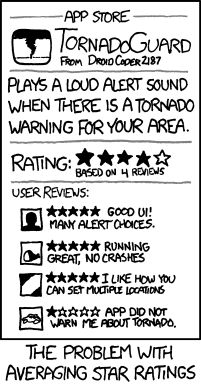
Friday's was especially timely. As I mentioned, on Thursday and Friday I went to a training (along with an extraordinary number of St. Joseph County's best and brightest) on Marzano's Formative Assessments and Standards-based Grading. One of the key ideas of Thursday's training is that a traditional, letter-grade-based-on-a-100%-scale grading system is almost useless, and that averaging grades together is no way to show a student what she has learned. (Friend and regular commenter Ray told me so in a comment in an earlier post.)
Friday morning's XKCD:
Wednesday, August 10, 2011
Another educator who does everything better than me...
...writes a blog better than I do.
Peter Pappas's blog Copy / Paste seems full of practical suggestions to do the kinds of things I want to do in my classes: project-based learning, student-centered and student-directed educational practices, critical thinking skills crammed into everything, clear and effective communication skills. I was introduced to him through Larry Ferlazzo's blog.
Some favorite posts so far:
First day of school? Here's how to get students thinking. Instead of passing out books, going over rules, etc., give your students an engaging puzzle to solve that involves communication and analytical thinking. And then, just for kicks, have them think reflectively about the whole experience.
A taxonomy of reflection. An application of Bloom's taxonomy of thinking to reflecting on learning. This is the first of a four-part series. It's an interesting framework for reflection.
Teachers, have the courage to be less helpful. 4 key points on how to make your classroom more student-centric.
How to tell a story: Five rules for better writing. Actually a cross-post from someone else, but still good.
Peter Pappas's blog Copy / Paste seems full of practical suggestions to do the kinds of things I want to do in my classes: project-based learning, student-centered and student-directed educational practices, critical thinking skills crammed into everything, clear and effective communication skills. I was introduced to him through Larry Ferlazzo's blog.
Some favorite posts so far:
First day of school? Here's how to get students thinking. Instead of passing out books, going over rules, etc., give your students an engaging puzzle to solve that involves communication and analytical thinking. And then, just for kicks, have them think reflectively about the whole experience.
A taxonomy of reflection. An application of Bloom's taxonomy of thinking to reflecting on learning. This is the first of a four-part series. It's an interesting framework for reflection.
Teachers, have the courage to be less helpful. 4 key points on how to make your classroom more student-centric.
How to tell a story: Five rules for better writing. Actually a cross-post from someone else, but still good.
Tuesday, August 9, 2011
The trouble with grades
How many times have I written about grades? (Well, Señor, if you were better about tagging your posts, you'd be able to find out.) I'm brushing up my syllabi for the coming school year, and I'm pleased to note that relatively little needs changing for the first week or two of school. This is excellent, and now I can focus on the other 34 weeks of school. I feel like I'm in a position, finally, to begin with the end in mind. (If you parse that sentence carefully, it's full of false assumptions, logical inconsistencies, two or three confessions of less-than-best practice, and possibly a spelling mistake.)
One of the things we did in teacher college (I say it that way to liken it to "clown college," a slightly more prestigious organization) was to write out course-long rubrics. "An A student in this class will have these attributes and display these skills and knowledge..." on down to at least a C student. We stopped at C because evidently D students weren't worth defining; they were defined as the not-quite-critical absence of the skills that made all the other students A, B, or C students, I guess.
Now I'm doing that for my 2nd-year Spanish students. This is an exercise I engage in periodically. It's based heavily on ACTFL performance standards. But they just don't fit nicely into grading categories. At the end of year 2 of high school Spanish, according to the state, students should be performing at a Novice High level of communicative ability: able to function in familiar, formulaic communicative settings, with limited re-formulation of the language. So, if that's the minimum required skill level, does that become a D-? A C? A B? An A? At what point am I penalizing students for not being outstanding?
I'm going to a training on Thursday and Friday. We're going to work on one of Marzano's books, I don't remember which off the top of my head, which talks about grading in a standards-based system. Hopefully I'll know more after that.
One of the things we did in teacher college (I say it that way to liken it to "clown college," a slightly more prestigious organization) was to write out course-long rubrics. "An A student in this class will have these attributes and display these skills and knowledge..." on down to at least a C student. We stopped at C because evidently D students weren't worth defining; they were defined as the not-quite-critical absence of the skills that made all the other students A, B, or C students, I guess.
Now I'm doing that for my 2nd-year Spanish students. This is an exercise I engage in periodically. It's based heavily on ACTFL performance standards. But they just don't fit nicely into grading categories. At the end of year 2 of high school Spanish, according to the state, students should be performing at a Novice High level of communicative ability: able to function in familiar, formulaic communicative settings, with limited re-formulation of the language. So, if that's the minimum required skill level, does that become a D-? A C? A B? An A? At what point am I penalizing students for not being outstanding?
I'm going to a training on Thursday and Friday. We're going to work on one of Marzano's books, I don't remember which off the top of my head, which talks about grading in a standards-based system. Hopefully I'll know more after that.
Tuesday, August 2, 2011
Advocating for our profession
More on this later:
http://teacherleaders.typepad.com/shoulders_of_giants/2011/07/why-teachers-must-advocate-for-the-teaching-profession.html
http://teacherleaders.typepad.com/shoulders_of_giants/2011/07/why-teachers-must-advocate-for-the-teaching-profession.html
Monday, August 1, 2011
That's a little more like it
This is what I like to see from the national-level leader of education in our country. (We can debate how important the national-level leader is in a system as de-centralized as ours some other time.) He says that teachers should start out making around $60,000 a year, and end their careers making around $150,000. We all know that he has been pushing a great many of the "reforms" that are so odious to teachers' unions: relaxed charter schools, increased "accountability" for teachers (and apparently some school-level administrators, as well), merit pay, etc. With this speech to the National Board for Professional Teaching Standards, he indicates his awareness that under current circumstances, there is no reason for any competent person to become a teacher. He also noted the political improbability of making that happen.
The teacher leader in me says that it's nice to see a national figure recognize something the appropriate value of teachers. The cynic says that it's nice to see a national figure make a symbolic buy-off that will score political points without costing anyone anything.
Every year, at the district I last worked at, the superintendent took Teacher Appreciation Week seriously. He and his wife would spend the week before that preparing little tokens of appreciation--satchels with messages of support, lapel pins of acorns ("The mightiest oak tree grows from an acorn"), and the like. One day during that week he would make breakfast for the staff. He would give a three-sentence speech, in effect saying, "I wish I could show my appreciation by paying you thousands of dollars, but instead I made you pancakes. Thanks for all your hard work." And we would all eat.
I've heard the wish for thousands of dollars, Secretary Duncan. Now I'm waiting for my pancakes.
The teacher leader in me says that it's nice to see a national figure recognize something the appropriate value of teachers. The cynic says that it's nice to see a national figure make a symbolic buy-off that will score political points without costing anyone anything.
Every year, at the district I last worked at, the superintendent took Teacher Appreciation Week seriously. He and his wife would spend the week before that preparing little tokens of appreciation--satchels with messages of support, lapel pins of acorns ("The mightiest oak tree grows from an acorn"), and the like. One day during that week he would make breakfast for the staff. He would give a three-sentence speech, in effect saying, "I wish I could show my appreciation by paying you thousands of dollars, but instead I made you pancakes. Thanks for all your hard work." And we would all eat.
I've heard the wish for thousands of dollars, Secretary Duncan. Now I'm waiting for my pancakes.
Saturday, July 23, 2011
Tech tools update
I looked at my calendar this morning, and found that it was the 23rd of July. The start of school is right around the corner. I haven't read a teacher tech blog in weeks, and those are normally among the highlights of the internet for me. So I looked at some of my RSS feeds, and a lot of really intelligent people are doing a lot of really cool things.
Via iLearnTechnology, we have Automatoon, an online animator that uses HTML5, not Flash, as its basis. This is important because Flash works badly on Macintosh computers, and not at all on iDevices. (There are also some philosophical reasons for HTML5 over Flash, but I only barely understand them, and wouldn't deign to try to explain them.) It's easy to use, and unlike other online animation features I've demonstrated here before (notably Go! Animate), with Automatoon it's relatively easy to start an animation from scratch, right down to the component pieces. It requires a little more freehand computer drawing skill than I have, but I imagine most of my students are better at it than me. This is a welcome addition to the world of visual learning tools and student-production-other-than-5-paragraph-papers tools.
Free Tech 4 Teachers points us in the direction of a QR code reader treasure hunt generator. QR codes are those square bar code things that you see everywhere from magazine ads about perfume to, er, other magazine ads about perfume. The idea behind a QR code, I guess, is that it's supposed to allow people with mobile camera devices to take a picture of the box and get a lot more information about whatever the code is attached to. I saw them the other day on the tags in house plants in Lowe's. Taking a picture of the code would take you to a website or something that gave you information on care and feeding of the plant, something that used to be printed on the tag. I guess they had to get rid of that information to make room for the QR code. I don't really get QR codes; I don't know what they're really good for. I feel like they're an answer looking for a question.
That makes them a perfect fit for the QR code treasure hunt generator: students have to go looking for the questions. *rimshot* The idea is that students take their device, equipped with an appropriate QR code reader app (and the site provides some suggestions on where to find them), and go searching the school for QR codes. They take a pic of the code with their device, the reader app reads it, and gives them a quiz-type question. Students punch in the answer, and they're off to find the next question. Setup seems easy enough: the teacher types the questions and answers (or copies and pastes them off of a text document) into the program provided, the program gives QR codes for each question, the teacher prints them off and hides them around the school. S/he gives the students X minutes; the ones who come back with the most correct answers wins.
Again, this feels like an "almost there" technology. I haven't fiddled with it yet, so maybe I'm missing something. What I'd like to be able to do with this is an Amazing Race-type event: The answer to the question is the location of the next question. Maybe it will work for that; I don't know. I intend to give it a try, but I'm not certain I get the advantage over doing exactly the same thing, but having students take pictures of themselves at the appropriate locations. If it's an excuse to turn short-answer quizzes into kinesthetic learning activities, I guess that's fine. It feels like it could be more so, though.
Via iLearnTechnology, we have Automatoon, an online animator that uses HTML5, not Flash, as its basis. This is important because Flash works badly on Macintosh computers, and not at all on iDevices. (There are also some philosophical reasons for HTML5 over Flash, but I only barely understand them, and wouldn't deign to try to explain them.) It's easy to use, and unlike other online animation features I've demonstrated here before (notably Go! Animate), with Automatoon it's relatively easy to start an animation from scratch, right down to the component pieces. It requires a little more freehand computer drawing skill than I have, but I imagine most of my students are better at it than me. This is a welcome addition to the world of visual learning tools and student-production-other-than-5-paragraph-papers tools.
Free Tech 4 Teachers points us in the direction of a QR code reader treasure hunt generator. QR codes are those square bar code things that you see everywhere from magazine ads about perfume to, er, other magazine ads about perfume. The idea behind a QR code, I guess, is that it's supposed to allow people with mobile camera devices to take a picture of the box and get a lot more information about whatever the code is attached to. I saw them the other day on the tags in house plants in Lowe's. Taking a picture of the code would take you to a website or something that gave you information on care and feeding of the plant, something that used to be printed on the tag. I guess they had to get rid of that information to make room for the QR code. I don't really get QR codes; I don't know what they're really good for. I feel like they're an answer looking for a question.
That makes them a perfect fit for the QR code treasure hunt generator: students have to go looking for the questions. *rimshot* The idea is that students take their device, equipped with an appropriate QR code reader app (and the site provides some suggestions on where to find them), and go searching the school for QR codes. They take a pic of the code with their device, the reader app reads it, and gives them a quiz-type question. Students punch in the answer, and they're off to find the next question. Setup seems easy enough: the teacher types the questions and answers (or copies and pastes them off of a text document) into the program provided, the program gives QR codes for each question, the teacher prints them off and hides them around the school. S/he gives the students X minutes; the ones who come back with the most correct answers wins.
Again, this feels like an "almost there" technology. I haven't fiddled with it yet, so maybe I'm missing something. What I'd like to be able to do with this is an Amazing Race-type event: The answer to the question is the location of the next question. Maybe it will work for that; I don't know. I intend to give it a try, but I'm not certain I get the advantage over doing exactly the same thing, but having students take pictures of themselves at the appropriate locations. If it's an excuse to turn short-answer quizzes into kinesthetic learning activities, I guess that's fine. It feels like it could be more so, though.
Subscribe to:
Posts (Atom)
